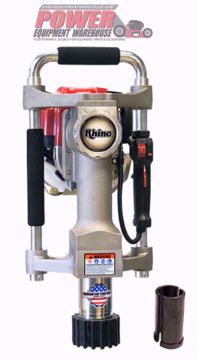
Rhino GPD45XA Post Driver
Video: Honda Engine Shroud on Rhino Post Drivers
The Rhino GPD45XA post driver is a highly versatile, gas-powered tool designed for efficiently installing a wide range of posts including T-posts, U-channel sign posts, small-diameter pipe, ground rods, and various fence or marker posts while offering solid depth capability, quick adapter changes, and reliable performance in most typical soil conditions. To use it for maximum efficiency, always match the correct Chuck-Lok sleeve or chuck to the post diameter to ensure a tight, energy-efficient fit, then position the driver squarely over the post, apply light steady downward pressure, and let the hammer action do the work rather than forcing the tool; this prevents premature wear, reduces operator fatigue, and minimizes risks like post bending or mushrooming. Maintaining consistent vertical alignment throughout driving is crucial for achieving uniform depth usually around 3–5 feet in average soils and if soil is particularly dense or rocky, pre-drilling or moistening the ground can dramatically improve results. For daily operation, the engine should be fueled with fresh, clean gasoline, the air filter should be inspected regularly, and mounting hardware, chucks, and sleeves should be checked for tightness before and during long sessions to maintain impact efficiency. Easy troubleshooting includes checking for incorrect adapter fit if driving seems slow, clearing debris or freeing a lodged post if vibration becomes irregular, and allowing the tool to cool or working in short bursts to prevent overheating in compacted soils. Consistent cleaning, lubrication, and storage in a dry environment keep the unit performing at peak power and using proper PPE; gloves, eye protection, hearing protection, and a stable stance ensures both speed and safety. With correct setup, good soil preparation when needed, attentive alignment, and routine care, the Rhino GPD45XA delivers fast, dependable post installation and maintains excellent long-term efficiency in a wide variety of work conditions.
What the GPD45XA Is & What It Can Do (Post Types & Depth Range)
Key Specs & Design Features
- The GPD-45 Multi-Pro XA uses a Honda GX35 4-stroke engine, delivering approx. 1720 blows per minute (bpm).
- The “XA” variant includes an extended anvil and a 2.5″-ID master chuck, providing flexibility to accept different adapter sleeves/chucks.
- It ships with 1″, 1¾″, and 2″ chuck-sleeves (Chuck-Lok system) enabling quick adaptation to different post sizes.
- With additional optional chucks/drive caps, the GPD45XA can handle a variety of post types: from T-posts and round pipe posts to square posts, channel posts (e.g. U-channel sign posts), tent stakes, ground rods, form pins, etc.
Post Depth & Soil Conditions — What to Expect
- According to the manufacturer’s general guidance for post drivers of this class, such drivers are designed to drive posts typically 3–5 feet deep in “light or medium” soils (soil with some humus, occasional gravel, light clay, etc.).
- The depth performance depends heavily on soil type. For heavier soils (compact clay, gravel, shale, rocky ground), the GPD45XA might struggle more; in those cases, a larger driver (or pre-drilling / pilot hole) may be recommended.
- The versatility of the chuck system means you can use the GPD45XA for various post jobs from sign posts to fencing, channel posts, ground rods, and lighter structural posts as long as the post diameter fits within the supported range and the ground conditions are manageable.
In short: GPD45XA is a flexible, mid-weight gas-powered post driver, good for T-posts, sign posts, channel posts, small to medium pipe/metal posts and practical for driving many posts down 3–5 ft in “normal” soils. For heavier soil or very deep embedment, you might need a heavier-duty driver or pre-drilling.
How to Use the GPD45XA — Setup & Best-Practice Technique
Here’s a recommended workflow and tips to maximize efficiency and post-quality:
- Select the correct adapter/chuck before you begin. Use the Chuck-Lok system’s appropriately sized sleeve or chuck for the post diameter. This ensures a snug fit and maximum impact transfer, reduces slippage, and protects the post top.
- Align carefully before striking. Make sure the post is vertical, the driver is centered over the post, and the chuck is seated properly; misalignment can cause crooked posts or damage. (This is standard best-practice for any powered post driver.)
- Use steady downward pressure + let the driver do the work. Don’t force the post: maintain light but controlled downward pressure and allow the hammer mechanism to drive the post. This reduces risk of mushrooming or bending posts.
- Work in short bursts (especially in hard soil). If the ground is tough or compact, use short “hammering” bursts instead of continuous running to prevent overheating, excessive wear, or post damage.
- Monitor depth / verticality as you go. Especially when installing multiple posts, re-check that each one is straight and going to the same depth; uneven depth or leaning posts compromise fence/sign integrity.
- Use proper PPE & posture. As with all gas-powered post drivers: wear safety glasses, hearing protection, gloves, and sturdy boots. Keep a stable stance (feet shoulder-width), grip firm but not overly tight, and avoid bending awkwardly.
- Switch post types efficiently. Thanks to the adapter system, you can go from T-posts to round pipe or channel posts without major downtime; just swap the appropriate chuck/sleeve.
Common Troubleshooting & How to Fix/Prevent Problems
If things go wrong, slow drives, jammed posts, post flare or mushrooming, etc. here’s what to check/do (general post-driver advice + what applies to Rhino):
| Problem | Likely Cause & Fix |
|---|
| Post driving slowly / engine sluggish | Could be due to soil being too compact/hard, or using an adapter that’s too large (loose fit). Solution: pre-drill a pilot hole or use a better-matched adapter. Frequent in heavy, dense soil. |
| Post gets stuck or lodged inside driver/chuck | If using adapter and post flares or jam occurs: shut off engine, remove locking nut, lift driver or use the pry gaps on adapter base to free. (This is standard fix for lodged posts.) |
| Post top “mushrooming” / flare (especially thin-wall or light-gauge pipe) | Use correct support head or drive cap for thin/weak posts; avoid over-driving or using max power on small-diameter posts. |
| Excessive vibration, operator fatigue, or risk of injury | Ensure vibration-dampening handles/grips intact, wear anti-vibration gloves, take regular breaks, don’t overuse without rest. |
| Depth or alignment uneven across multiple posts | Regularly check vertical alignment and use pre-marked depth markers or tape on post to know when desired depth is reached. |
Also, always follow the manufacturer’s maintenance schedule: clean after use, lubricate moving parts, ensure chucks/adapters are firmly seated, and check for wear before each job.
Tips for Best Efficiency & Safe, Consistent Results
- Use correct adapter sizing for each post job. Avoid trying to force posts of different diameter with wrong adapter; wastes time and risks damage.
- Plan your post layout & depth ahead. Mark posts with tape/paint for target depth; this helps when installing many posts in a row.
- Alternate workers if doing many posts. Having one person hold/align post while another operates driver speeds the job and reduces fatigue.
- In tough soil, pre-soak ground or pre-bore a pilot hole (if practical). This can make driving much faster and reduce wear on driver & posts.
- Maintain the driver diligently. Clean debris, lubricate per Rhino’s spec, check chucks/adapters, inspect for wear; keeps driving power consistent and extends lifespan.
What the GPD45XA Is Not ; Use It Within Its Limits
- It’s not a heavy-duty pile driver: it's designed for small-to-medium posts (up to ~2–2¼″ pipe or square posts ~2½″) and general post work, not for large structural posts or deep foundation piles.
- In heavy, compacted, rocky, or extremely dense soils, its ability to drive deeply or quickly may be limited. For those conditions, a larger driver or a different installation method may be needed.
- Thin-walled or light-gauge posts are at risk of deformation (flare, mushrooming) if over-driven; always match adapter and use gentle, controlled driving.
Don't forget to have grease (#300500), and a service kit (#301509 or 301525 - serial number specific) on hand during your tent installation season! Fast, easy maintenance will add longevity to your Rhino Driver!