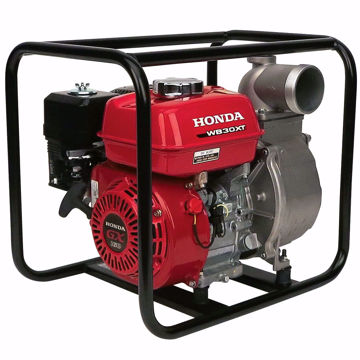
Honda WT30XK4A
The Honda WT30XK4A is a heavy-duty 3-inch trash pump designed for high-volume movement of dirty water, making it ideal for construction sites, flood control, irrigation ditches, and environments containing mud, sand, and debris. Built around Honda’s commercial-grade GX270 engine, it delivers up to 317 gallons per minute, with the ability to pass solids up to 1 1/16 inch, thanks to its cast-iron volute, conical impeller, and large metal suction strainer. Its robust build includes a stainless-steel wear plate and a silicon-carbide mechanical seal, allowing it to withstand continuous operation in abrasive conditions while reducing long-term maintenance costs. The pump features a wide clean-out port that makes removing trapped debris quick and easy, and Oil Alert engine protection that shuts the unit down if oil runs low. For best efficiency, always ensure the pump is fully primed, the suction hose is airtight, and the strainer is clear of large debris; avoid running the pump dry to protect the mechanical seal. Operating on stable, level ground minimizes vibration and improves overall performance, while using correctly sized hoses and minimizing unnecessary head height increases flow efficiency. Routine maintenance: checking oil, cleaning the air filter, inspecting the impeller and wear plate, and draining the pump housing after use keeps the unit running smoothly and prevents premature wear. Troubleshooting typically involves checking for priming issues (often caused by air leaks), clearing impeller blockages, verifying proper fuel and oil levels, and inspecting hose connections or clogged strainers when flow drops. When properly maintained and operated within spec, the WT30XK4A is one of the most reliable and efficient trash pumps in its class, capable of fast water removal, dependable solids handling, and long service life in demanding environments.
What Is the Honda WT30XK4A (or similar “WT30” Pump) / Key Specs
- The Honda WT30XK4A Trash Pump is a heavy-duty, 3-inch “trash pump” designed to move water with solids (i.e., dirty water or water with debris).
- According to Honda’s specs, it has a capacity of 317 gallons per minute.
- It can handle solids up to 1 1/16 in (i.e., relatively large debris) without clogging.
- The pump uses a cast iron volute and cast iron impeller, which is more robust / wear-resistant.
- It has a silicon carbide mechanical seal (pump case to impeller), which is good for durability in abrasive environments.
- The engine: Uses a Honda GX270 (270 cc) commercial OHV engine.
- Priming time: ~90 seconds at a specified lift (~16.4 ft) per spec sheet.
- Head lift (maximum): ~82 ft total head lift, per spec sheet.
- Weight: dry weight is about 134 lb.
- Fuel: 1.4-gallon fuel capacity, typical run time is ~1.5 hours at max discharge.
- It has Honda Oil Alert, which shuts the engine off when oil is too low to protect it.
- Frame: Has a full protective frame, making it more rugged and easier to transport / tie down.
- Service / Maintenance: There is a quick clean-out port to help service the pump case.
“Disposal Capabilities” (i.e., Solids-Handling)
- Solids Handling
- The pump is explicitly described by Honda as a trash pump, meaning it's designed to pass solids. Solids up to 1 1/16 inch in diameter can go through.
- The impeller is conically shaped, which helps with priming and moving debris.
- There’s a large heavy-duty metal strainer (on the suction side) this helps block very large debris or big junk from entering and damaging the impeller / seal.
- Wear Resistance
- The pump’s volute (the housing) and impeller are made of cast iron: gives strength and resists wear.
- The wearing surface inside (where the impeller rubs) has a replaceable stainless steel wear plate, increasing longevity and allowing easier repair.
- The mechanical seal is silicon carbide on both sides, this is a very hard, wear-resistant material suited for abrasive particles.
Troubleshooting Tips
Here are common issues you might face with a trash pump like this, and how to fix or mitigate them:
- Priming Problems
- Make sure the priming port is open / correctly used when you start. If the pump doesn’t prime, no suction.
- Check for leaks in the suction hose. Any air leak will prevent priming.
- Use clean water (at first) to prime; if the water has very large debris, it might obstruct priming.
- After priming, make sure the priming plug is securely tightened.
- Clogging / Blocked Impeller
- If flow drops dramatically or the pump surges, it may be clogged. Use the clean-out port to access the volute and impeller. Honda’s design allows relatively quick clean-out.
- Inspect the strainer on the suction side for large debris and clean it.
- If solids are too large (over spec), they might clog or damage; avoid feeding extremely large trash.
- Engine Problems
- Check oil level, since the pump has Oil Alert, if oil is low, the engine might shut off or not start reliably.
- Use the recommended oil viscosity / type.
- Check the air filter; if it's clogged, the engine may run poorly.
- Check spark plug: fouled or worn plug can make starting difficult.
- Vibration / Overheating
- Make sure the pump is mounted securely on a stable surface. The frame helps, but soft ground or uneven setup can lead to excessive vibration.
- If running for long durations, monitor oil temperature (if you can) and the pump body. Overheating may damage seals.
- Make sure cooling air to the engine is not blocked.
- Seal Wear / Leakage
- If you notice leaks around the pump casing, the mechanical seal may be worn. Over time, debris can wear the seal.
- Use the service tool to disassemble the pump case; replace the stainless wear plate or seal as needed.
- Fuel / Running Time Issues
- Make sure fuel is fresh; stale or contaminated fuel can cause engine problems.
- Drain fuel if storing for a long time.
Best Practices for Efficiency
To run this pump most efficiently (in terms of fuel, wear, maintenance, and performance):
- Match Pump to Task
- Use it for applications it’s designed for: high-volume dirty / trash water. Don’t push it to handle things far beyond what it’s rated for (e.g., huge boulders or big solids).
- Choose hose diameters that minimize friction loss; too small a suction or discharge hose reduces efficiency.
- Proper Priming
- Prime properly before starting: it only takes ~90 seconds to prime (per spec), so don’t force the engine to suck air.
- Minimize air leaks in suction line so the pump doesn’t lose prime.
- Maintenance
- Regularly clean the strainer / suction intake prevents large debris from damaging internal components.
- Inspect the wear plate and impeller periodically; replace if you see signs of wear.
- Change or top up oil in the engine on schedule (per engine manual). Use good-quality oil.
- Run the pump periodically if not used, to keep seals lubricated and to prevent rust / corrosion (depending on storage).
- Operation Techniques
- Avoid running dry: don’t run the pump without water, as that can damage the mechanical seal.
- Use throttle control: if your engine / pump allows, don’t always run at full throttle; match engine speed to pumping demand.
- Monitor discharge pressure / head: if you’re pumping into a very long or high hose, make sure you’re not overloading the pump’s capability (check head loss).
- Storage
- If storing between uses, drain water from the pump body to prevent freezing / corrosion.
- Drain fuel (or use fuel stabilizer) if it will sit for more than a month or so.
- Store in a dry, sheltered place to protect the engine and pump components.
Safety Considerations
- Always wear PPE (gloves, eye protection) debris can be dangerous, especially when priming or cleaning.
- Be careful of hot surfaces on the pump / engine during and after operation.
- Use proper hoses rated for the flow and pressure you're working with.
- Make sure the pump is on stable ground and cannot shift during operation.